


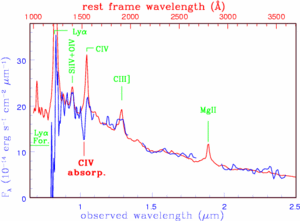
Due to the cosmological redshift many of the most interesting features of the most distant quasars are shifted into the near-IR band, a spectral region where the reduced sensitivity of past instrumentation prevented a detailed study of many of their spectral features. The Near Infrared Spectrograph (NICS) operating at the TNG has been equipped with a low dispersion-high throughput element (an Amici prism) which enables to study the broad spectral features typical of quasars with unprecedented sensitivity.
The blue line in the figure above shows the near-IR spectrum of the most distant quasar known, SDSS J104433.04-012502.2, at z=5.80, obtained at the TNG during the commissioning of NICS. The red line is a template obtained by the combination of a sample of quasars at z~1. The most intersting result is the blueshifted absorption feature of the CIV. This feature classifies this object as a Broad Absorption Line quasar. The blueshifted CIV absorption is ascribed to gas outflowing with velocities in excess of 10000 km/s. This finding, combined with the recent observation of this quasar in the X-rays with the XMM-Newton satellite (astro-ph/0010328), suggests that the outflowing gas obscures the quasar in the X-rays with a column of gas larger than Nh > 1024 cm-2, i.e. a brick-wall made of a huge amount of gas. The implied outflow of mass ejected into the intergalactic medium is larger than 5 solar masses per year!
For more details see the paper recently accepted on Astronomy & Astrophysics (astro-ph/0104147).